Projects
The Anthropocene Sediment Network runs and supports a range of multidisciplinary projects. If you would like to run a project with us, or have your project listed here, please e-mail c.russell@lboro.ac.uk
Project Calls
Plastics in the Sedimentary Record of the Anthropocene
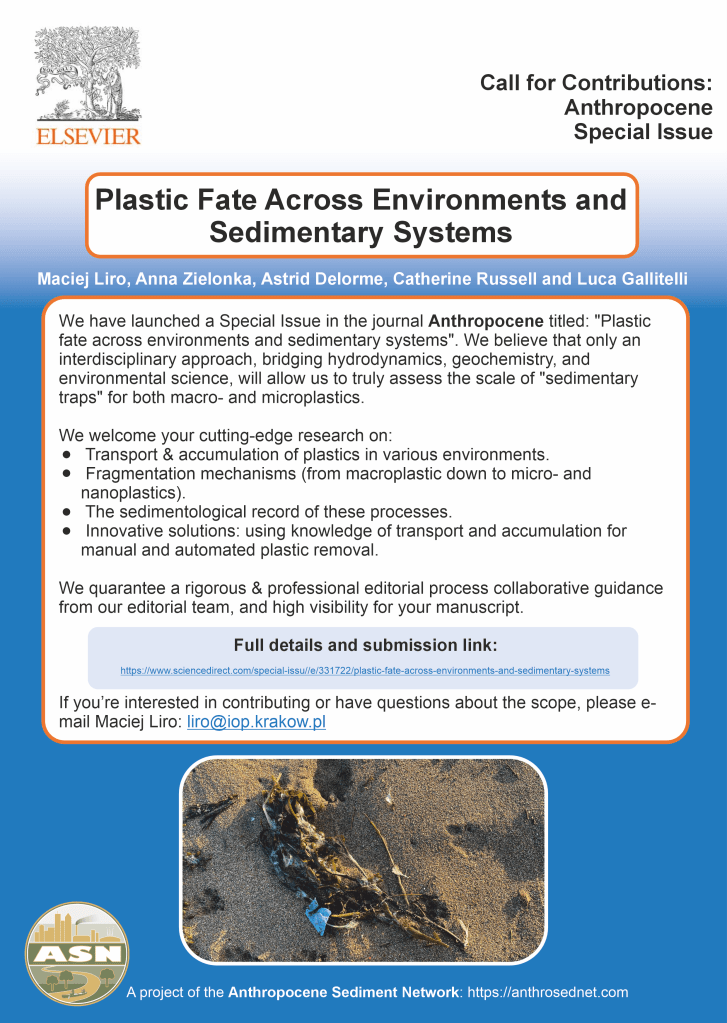
Call for Contributions
We’re happy to support a Special Issue in the journal Anthropocene which welcomes cutting-edge research on:
– Transport & accumulation of plastics in various environments
– Fragmentation mechanisms (from macroplastic down to micro- and nanoplastics)
– The sedimentological record of these processes
– Innovative solutions: using knowledge of transport and accumulation for manual and automated plastic removal
If you have any questions, please e-mail Maciej Liro: liro@iop.krakow.pl
Active Projects
The Present and Future Geology of Anthropogenic Materials
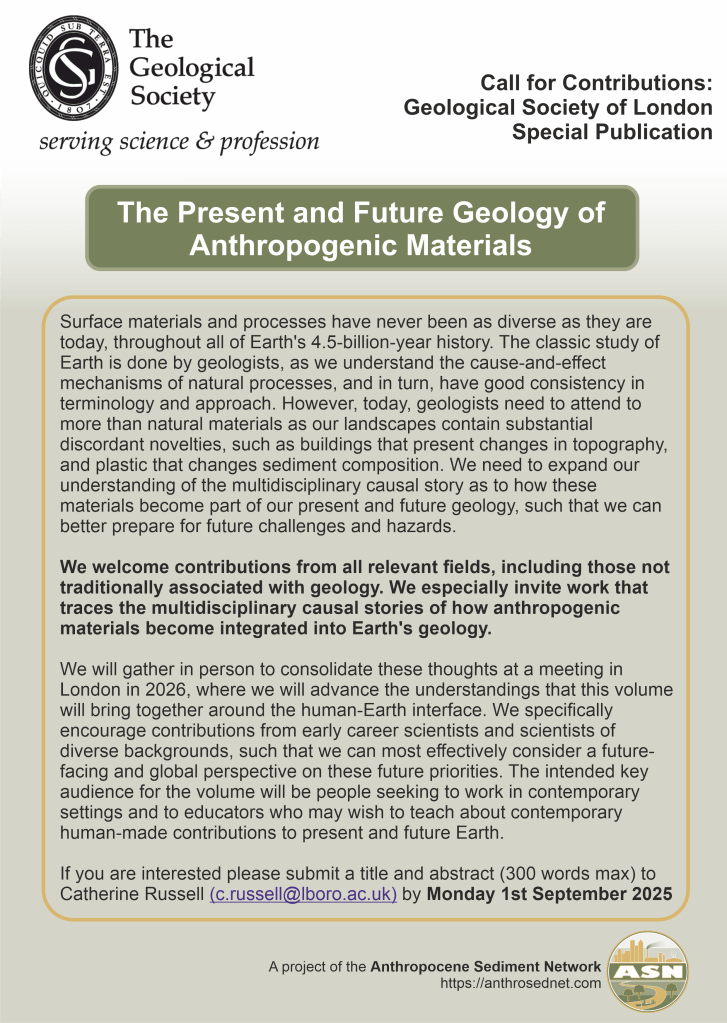
We are producing a special issue with the Geological Society of London, focused on the materials that are reshaping the geologic archive. Whilst submissions are closed, we will run an open meeting next year, and all are welcome to attend!
Submissions Closed
Funded by:

More Information
Surface materials and processes have never been as diverse as they are today, throughout all of Earth’s 4.5-billion-year history. The classic study of Earth is done by geologists, as we understand the cause-and-effect mechanisms of natural processes, and in turn, have good consistency in terminology and approach. However, today, geologists need to attend to more than natural materials as our landscapes contain substantial discordant novelties, such as buildings that present changes in topography, and plastic that changes sediment composition. We need to expand our understanding of the multidisciplinary causal story as to how these materials become part of our present and future geology, such that we can better prepare for future challenges and hazards.
We welcome contributions from all relevant fields, including those not traditionally associated with geology. We especially invite work that traces the multidisciplinary causal stories of how anthropogenic materials become integrated into Earth’s geology.
We will gather in person to consolidate these thoughts at a meeting in London in 2026, where we will advance the understandings that this volume will bring together around the human-Earth interface. We specifically encourage contributions from early career scientists and scientists of diverse backgrounds, such that we can most effectively consider a future-facing and global perspective on these future priorities. The intended key audience for the volume will be people seeking to work in contemporary settings and to educators who may wish to teach about contemporary human-made contributions to present and future Earth.
If you are interested please submit a title and abstract (300 words max) to Catherine Russell (c.russell@lboro.ac.uk) by Monday 1st September 2025.
Geoscience Disrupted: A Guide to Anthropocene Sediments
Editors: Alessandro Brunazzo, Alejandro Camargo, Catherine Russell
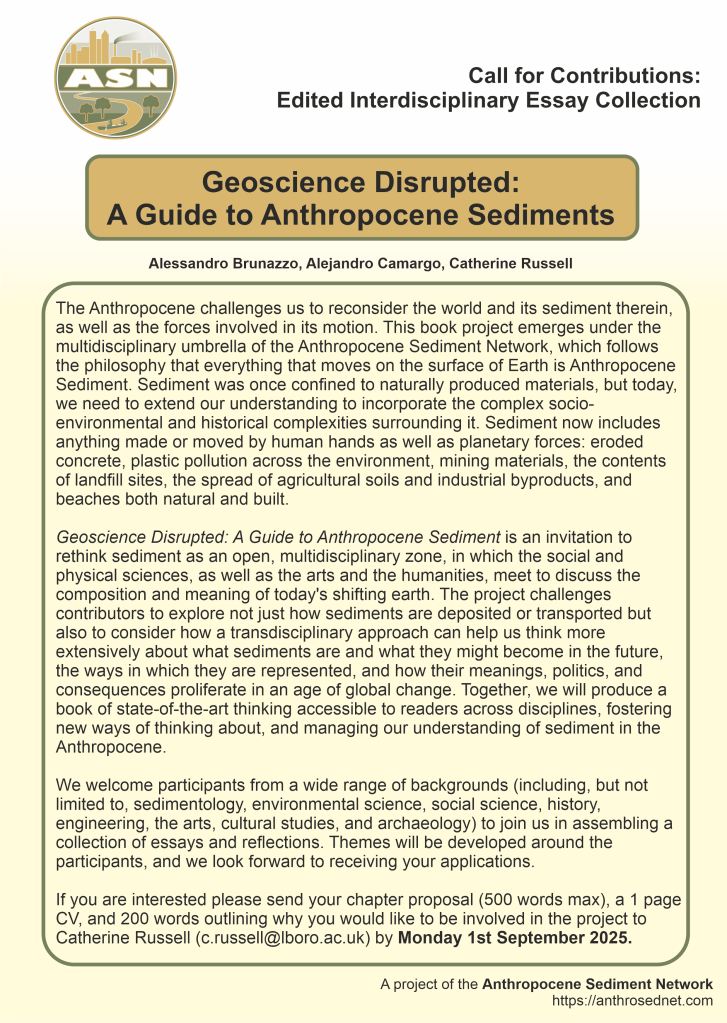
We are making an interdisciplinary essay collection exploring sediment in motion, accumulation, record, and meaning.
Submissions Closed
Funded by:

More Information
The Anthropocene challenges us to reconsider the world and its sediment therein, as well as the forces involved in its motion. This book project emerges under the multidisciplinary umbrella of the Anthropocene Sediment Network, which follows the philosophy that everything that moves on the surface of Earth is Anthropocene Sediment. Sediment was once confined to naturally produced materials, but today, we need to extend our understanding to incorporate the complex socio-environmental and historical complexities surrounding it. Sediment now includes anything made or moved by human hands as well as planetary forces: eroded concrete, plastic pollution across the environment, mining materials, the contents of landfill sites, the spread of agricultural soils and industrial byproducts, and beaches both natural and built.
Geoscience Disrupted: A Guide to Anthropocene Sediment is an invitation to rethink sediment as an open, multidisciplinary zone, in which the social and physical sciences, as well as the arts and the humanities, meet to discuss the composition and meaning of today’s shifting earth. The project challenges contributors to explore not just how sediments are deposited or transported but also to consider how a transdisciplinary approach can help us think more extensively about what sediments are and what they might become in the future, the ways in which they are represented, and how their meanings, politics, and consequences proliferate in an age of global change. Together, we will produce a book of state-of-the-art thinking accessible to readers across disciplines, fostering new ways of thinking about, and managing our understanding of sediment in the Anthropocene.
We welcome participants from a wide range of backgrounds (including, but not limited to, sedimentology, environmental science, social science, history, engineering, the arts, cultural studies, and archaeology) to join us in assembling a collection of essays and reflections. Themes will be developed around the participants, and we look forward to receiving your applications.
If you are interested please send your chapter proposal (500 words max), a 1 page CV, and 200 words outlining why you would like to be involved in the project to Catherine Russell (c.russell@lboro.ac.uk) by Monday 1st September 2025.
 The Anthropocene Sediment Network